Thursday, 6 June 2019

NHS Assets up for grabs in fire sale

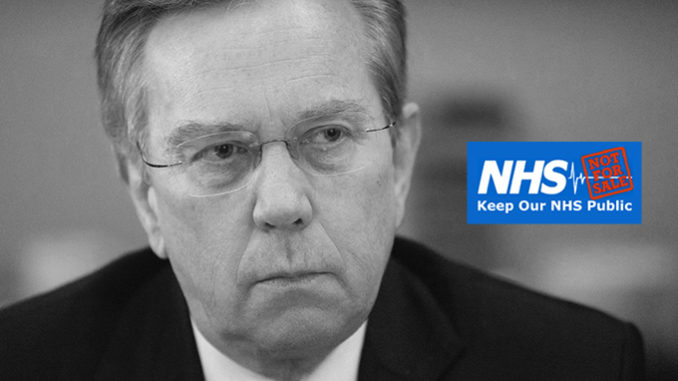
Sir Robert Naylor proposes selling off NHS land and buildings

NHS for SALE, SELLING OFF ASSETS by the POUND


As with KOSHH campaign and Epson & St Hellier hospitals, all NHS trusts are selling off NHS estate following the Naylor report well under market value, knowing they will recoup the losses due to the 2 for 1 offer (match funded) by the Tory government

There's also a threat in the Naylor report that states if hospital trusts don't accelerate the disposal of NHS estate (to private developers) they will not be eligible to access much needed money for patient care and equipment (running costs).


Fire Sale, it started long ago..

If your'e a hospital trust in deficit, and let's face it most are, there's a good chance you'll be advised to sell of some of the estate to private developers for LESS than market value: so the incentive is to flog off NHS estate using NHS Property services Ltd who own all NHS estate (assets) after they were transferred in-line with the 2012 Health & Social Care act.

The Naylor report is an NHS asset stripping document. NHS Property services Ltd is run by the CEO of NHS England Simon Stevens, the previous president of UnitedHealth, Americas largest private health insurer.

BELOW: CHRIS's video on Naylor report - A MUST WATCH!


Wednesday, 29 May 2019

STP lead apologises over poor state of mental health

Lancashire's STP lead 'apologises over poor state of mental health' on her watch

A recent report of urgent mental health commissioned by Lancashire & South Cumbria STP has been criticised after it was revealed mental health patients had received a lack of response from crisis teams, with some left on trolleys in hospital corridors overnight.

Amanda Doyle, a doctor and lead officer for the currently trialled non-mandated 'integrated care system' which includes mental health, admitted the report painted “a clear picture of where we have gone wrong and what we need to do to improve”.

Caroline Donovan, chief executive of Lancashire Care NHS Foundation Trust, said: 

“We welcome this report and its recommendations even though it makes for very difficult reading for all of us involved in the delivery of mental health care. We are so sorry that our services have, in many instances, fallen way short of what we aspire to, and that our patients and families deserve".

Full story from the Lancashire Evening Post
 Mentally ill patients in Lancashire suffer distressing waiting times

Tuesday, 9 April 2019

whilst you were distracted with BREXIT the NHS shrunk

WHILST YOU WERE DISTRACTED.....THE NHS SHRUNK..


In 2016, Labour Peer Lord Patrick Carter was asked to carry out a review by the then Conservative health secretary Jeremy Hunt as part of Hunt's aim to make the NHS a more efficient healthcare system.

Ten years earlier, Jeremy Hunt and others wrote about how this 'efficient healthcare system' was to be implemented in a Tory policy paper titled 'direct democracy'.

The policy paper called for the NHS to be replaced by an insurance system "breaking down the barriers between public and private providers, effectively 'denationalising' (privatising) the NHS in England".

The ball was rolling, all was needed was support,,,,, from anywhere and any party.....

As per Hunt's wishes, Labour peer Patrick Carter [lord Carter of Coles] spent 18 months visiting hospitals across England reviewing productivity to ensure the NHS gets the best value from its £102 billion annual budget and help the NHS to implement Jeremy Hunt's 7-day service, much hated by junior doctors and NHS staff .

Pathological Traitor?

As a reward, Lord carter of Coles, 73, become a non-executive director of the regulator NHS Improvement in April 2016 and was given carte blanche to transform how pathology should be reduced to a hub and spoke model, vastly cutting hospital pathology labs and replacing them with one or two county-wide labs serving smaller clinics/hospitals. A model VERY similar to that in the USA.

Since 2016, Labour peer Lord Carter has been adviser to Health Secretary Jeremy Hunt and the link below shows his final report.

In his review, Lord Carter looked at healthcare systems abroad, including the United States, to see how savings made in the private healthcare sector could be introduced into the English NHS.

Following on from Carters US healthcare 'efficiency savings' ambitions, NHS England are in the process of 'transforming' the NHS into a system used in the USA called Accountable Care Organisations (ACOS).

The CEO of NHS England is non other than ex Labour councillor and adviser to Tony Blair 'Simon Stevens'. Mr Stevens spent 10 years working for American private healthcare firm United health, and moved back to England in 2012 to implement what he had learned from the private sector into the NHS in England.

WIKI
Simon Stevens was educated at a state comprehensive, St. Bartholomew's School, and won a scholarship to Balliol College, Oxford University where he was president of the Oxford Union in the same academic year as friend Boris Johnson.

Simon Stevens 'healthcare manager'?
https://en.wikipedia.org/wiki/Simon_Stevens_(healthcare_manager)

Lord Carter's Review - cuts and shrinkage of the NHS in England
https://www.gov.uk/government/news/review-shows-how-nhs-hospitals-can-save-money-and-improve-care

Tuesday, 2 April 2019

outpatient services to be fragmented across private clinics


Bulk of hospital outpatient services to be fragmented across private clinics...

Lancashire County Councils 'Health scrutiny committee' have agreed as an accurate record a report in the previous minutes about the 'integrated care system' (ICS) proposed for Lancashire (and south of Cumbria). The ICS system consists of a mean-spirited 'up front loaded' budget that will be 'demand managed' by a plethora of private/public bodies with little accountability to the public.

The ICS was established in an attempt to curtail the demands placed on hospitals and the NHS budget after the introduction of 'GP-led clinical buying and selling groups' (clinical commissioning groups or CCGs for short).

The minutes from the 5th Feb 2019 meeting say "The proposals to change the [hospital] services provided aimed to improve public health and wellbeing and therefore reduce the demand on hospitals".

Those pushing the ICS however do not reveal just 'how' the closure of hospital outpatient services would result in improvements to the health and wellbeing of the public.

This does mean though a large bulk of hospital outpatients services, those in demand by the private sector, will be closed and shipped out of hospitals into private-public run clinics cited in CCG literature as 'Multi-specialty Community Provider' (MCP) clinics.

Currently, the hospital services are provided by Lancashire Teaching Hospitals NHS foundation Trust who recently declared a substantial deficit along with its hospitals in Chorley and Preston being found 'requiring improvement' overall for the second year running by the Care Quality Commission.

NHS campaigners fear that due to its large deficits the hospital trust may agree to any scheme CCGs propose, including selling off NHS hospital land, buildings, and NHS service contracts.

The proposal to close many hospital services tallies with an earlier report from a task group named the system design team setup by the local CCGs to analyse feedback from public events regarding proposed radical changes to local GP, hospital, and socially provided and means-tested services...
In Feb-2017 the system design group proposed moving 80% of patients currently seen in an acute [hospital] setting will not be seen there in future. source: Solution Design Event 5 Feedback Document. Exercise 1: Modelling Assumptions with Locality and Hospital Care group validation
Subsequently, in a news article out yesterday about long hospital waiting lists the Lancashire Teaching Hospital NHS 'foundation' trust say they are looking at sourcing 'alternative providers' in an attempt to reduce the backlog of 'NHS' patients waiting for elective operations.


Wednesday, 13 March 2019

County Council cut ill-health prevention services and tell people to go for a walk instead


Cutting prevention services across Lancashire will result in increases in demand on other NHS services. Yet Lancashire County Council can't seem to grasp this concept...

The Conservative ruling elite at county hall in Lancashire have come up with proposals to CUT over 6 social health intervention & prevention services that affect the most vulnerable in society.

At a national level, government claim they wish to strongly promote prevention services as these support their 10-year NHS plan. Yet in the same swing of the axe, the Tories intend CUTTING benefits and services forcing more people into needing the very social services they are cutting. Here's hypocrisy.....

"We propose to stop offering specific physical activity and healthy weight programmes which currently target those people exercising for less than 30 minutes three times per week and/or with a BMI of between 25 and 34.9".

In its place, the Tories say people can go for a walk in the park instead...

"However, we are proposing to develop a programme for everyone in Lancashire, promoting the use of the county's existing assets ..in particular in open and green spaces. This would be through activities such as walking, running and cycling in urban, coast and countryside locations.."

Chorley, South Ribble & Preston are under threat of losing A&E services along with many outpatient services under a program ineptly titled 'our health our care'.

A plan has been drawn up by health bosses which totally sidelines the issues of emergency care in the region and instead wishes to 'create an atmosphere of prevention of ill-health leading to a healthier lifestyle to prevent people visiting hospital or the doctors".

They can't have it both ways, health intervention and prevention services will need to be increased to offset any existing NHS service closures.
County hall needs to understand that cutting prevention services is contrary to the 'our health our care' plans they are consulting on later this year [2019].
If they are hell-bent on cutting prevention services; then existing NHS support services will continue to be heavily used and demand will only increase.

It's not rocket science, they can't have it both ways. Cutting prevention services will result in increases in demand on other NHS services!

 You really couldn't make this up!

for the chop.....


  • Lancashire Wellbeing Service (LWS) : LWS supports those adults most at risk of a health or social care crisis to remain healthy and well.
  • Active Lives Healthy Weight service
  • The Integrated Home Improvement Service (also known as Care and Repair).  home improvements and adaptations for disabled people - provides help to people in need of extra support to make their homes safe and accessible, by assisting homeowners to maintain, repair and improve their properties.
  • drug and alcohol rehabilitation service:  mainly residential based programmes, with a small number of day programmes. Rehabilitation is an abstinence-based set of interventions to address the underlying causes of addiction in order to establish new ways of coping in real-life situations following treatment.
  • Stop smoking services - Health Improvement Service consultation
  • Lancashire Break Time: a county-wide service providing short breaks for parents or carers of children and young people with special educational needs and/or a disability (SEND). The child or young person will attend a fun group activity whilst their parent or carer gets a short break from their caring role.

Related Link(s)

Wednesday, 9 January 2019

hospital trust employ 'bad' rated parking company

What 296 customers said about ParkingEye (source: Trustpilot)
When implementing an unpopular system, only to discover it's not working, rest assured you can watch your recruitment and retention rates fall, and your deficit grow. 

With all the chaos at Chorley and Preston hospitals due to the new hospital parking system, it's as though the hospital trust don't want anyone at their (OUR) hospitals at all.

Preston hospital car parks were strapped for space no doubt but the lack of ground maintenance was apparent for all to see, a rubble and shambles. The excuses used by the trust to justify bringing in the most hated parking company 'Parking Eye' doesn't wash with anyone.

At least anyone outside the 'trust board' fraternity.

A more friendly intercom barrier system has been replaced with a hostile 'Pay or Else' big brother camera that haunts your waking hours waiting to pound your front door carpet with its penalty charge notice.

A worrying and sickening thought for those already stressed about their loved ones who lay poorly in a hospital bed.

Not content with doubling the parking fees and charging disabled people to park, Lancashire teaching hospitals NHS trust then add insult to injury by bringing in the countries most hated private parking company 'Parking Eye' to ensure penalties and profits are maximised for both parties!

The new camera parking system implemented just before Christmas was a yuletide insult to staff, patients and visitors. How much disrespect can one show to those who pay their wages?

The trust claim there are teething problems with the new parking system, yet when the machines fail, the Parking company, apparently based in Buckshaw village, are nowhere to be seen.

This has left the trust having to send extra staff out to appease drivers stood ranting and raging at the faulty pay machines, whilst the queues get longer and longer...

The trust's website identifies the trusts 'council of governors' - (democratically elected by local people) as representing their local communities, and working together with the trust board to advise and influence how the hospital trust develop and deliver services.

Automatic Number Plate Recognition (ANPR)
The proposal for the new ANPR hospital parking system however was heavily criticised by the council of governors but instead of heeding the advice the trust tried to gag the peoples voice and when things went wrong they suspended the governor who spoke out.

Only 12 weeks ago it was reported that the Lancashire teaaching hospital trust charged their own staff over half-a-million £pounds to park at their place of work! They then reined in over £1.75 million in car parking fees taken from patients and visitors to the hospitals, sickening in itself.

This trust board were reprimanded in an independant review for not acting sooner and recruiting staff to avoid closure of the A&E at Chorley & South Ribble district hospital in 2016.
The board didn't listen then, and they've STILL not learned the lesson as they don't appear to be listening now. 
It's seems apparent the trust board do not have the interests of the public they serve as priority. With a £43m deficit, the new car parking scheme is just another funding stream that not only fails at the first hurdle, but has infuriated staff, patients and visitors to the extent nobody wants to visit or work there anymore.
Well done Lancashire Teaching Hospitals NHS foundation trust, pat yourselves on the back whilst you watch staff recruitment and retention rates fall, and your deficits grow. 


Related


(New parking charge strategies have been labelled "scrooge tactics" and "a tax on the sick" by critics).


Friday, 23 November 2018

Are Chorley and Grantham A&E closures being pushed through on safety grounds

Are Chorley & Grantham required STP changes being pushed through on 'safety grounds' ?

"STPs cannot solve the problem of inadequate funding. Ministers will have to fund the NHS properly or take political responsibility for its collapse".
following excerpt from The Sustainability and Transformation Plans: a critical assessment John Lister, Centre for Health & the Public Interest

At the end of the day, when the innovations in STPs don’t deliver savings for the NHS, NHS England will again resort to cuts and rationing. Indeed many knowledgeable people see the STPs as a smokescreen to divert attention from cuts at trust level, whittling away staffing levels, imposing smaller-scale service reorganisations, and preparing to push through controversial closures on ‘safety’ grounds (as has happened in Grantham and Chorley and is increasingly on the cards in Ealing).

Currenty, Lancashire Teaching Hospitals NHS foundation Trust are £43m in deficit.

How did the trust providers get into such a mess? 

The answer is pretty simple. Every year between 2010-11 and 2015-16 the amount hospitals were paid for each treatment they provided was cut, year after year. That meant that by 2015-16, a hospital was paid the equivalent of £820 to treat a patient they would have been paid £1,000 to care for in 2010-11.

Hospitals tried to balance their books by cutting their costs by around 13 per cent over the same period. But the amount they were paid was cut even faster – by around 18 per cent, resulting in the expenditure-over-income deficit we see today.’

Under-funded hospitals are indeed failing to meet their targets.
More than 10% of elective patients (364,000) are waiting over 18 weeks to start treatment, missing the time limit supposedly guaranteed under the NHS Constitution.

....abstractions like ‘integration’ and ‘self care’, to be found in every STP, distract attention from unpopular changes, and ignore facts on the ground. Public health programmes are actually being cut back across the country as a result of cuts in local government funding, so there is no money for the new prevention schemes that would be required to reduce the need for care, or for projects to tackle seriously the social determinants of health – which in any case would take years to show any measurable reduction in pressure on the NHS. Yet many if not all STPs rely on public health action to significantly reduce the ‘demand’ for services.
  • Primary care is already floundering: with more and more practices unable to cope with ever-increasing pressure, many GPs are leaving and are increasingly hard to replace, while Jeremy Hunt’s promise to recruit 5,000 more GPs plainly lacks credibility.
Many STPs seek to paper over the cracks, proposing that other, less qualified – and yet to be recruited –staff will take over a lot of the work now done by GPs.
As for community health services, some rural STPs involve closing community hospitals, with Cumbria and Devon expecting patients to travel up to 50 miles on sometimes hazardous roads when they need hospital care. None of the STPs addresses travel issues for elderly, less mobile patients, or single parents.

Even where community and home-based health or care services have been shown to be effective in enhancing patient care, they don’t save money, but cost more.

Yet STPs are required to save money, to enable the NHS to deliver more services to more people and absorb more cost inflation and cost pressures over the next four years, and wipe out existing deficits.

Many questions also hang over the proposals, more developed in some STPs than others, for the development of new forms of organisation of health care through US-style Accountable Care Organisations (now called Integrated Care Partnerships), as outlined by Simon Stevens in the Five Year Forward View. Many of these schemes are for the medium or longer term, and none of the proposals explain how they are supposed to improve services while at the same time saving money.

Indeed far from being cheaper to run, ACOs in the USA receive and require far higher spending per head than any British equivalent could even dream of, with allocations between 3 and 5 times higher than the average £2057 spent per patient per year in England’s NHS – a figure which many STPs explicitly seek to further reduce.

Nor do STPs address the consequences for existing NHS and Foundation Trusts of establishing new contracts and provider organisations, or the proposed reductions in caseload and funding for existing providers which are central to the expected cost ‘savings’.

Since acute trusts are largely paid only for the patient care they deliver (‘payment by results’), a reduction in caseload in one service can trigger the collapse of viability of related services and pull the financial rug from already indebted trusts.

Conclusion

At the end of the day, when the innovations in STPs don’t deliver savings for the NHS, NHS England will again resort to cuts and rationing. Indeed many knowledgeable people see the STPs as a smokescreen to divert attention from cuts at trust level, whittling away staffing levels, imposing smaller-scale service
reorganisations, and preparing to push through controversial closures on ‘safety’ grounds (as has happened in Grantham and Chorley and is increasingly on the cards in Ealing).

Up to half of most STPs’ planned savings are in any case to be squeezed out of the hospital sector, through ever more relentless ‘efficiency savings’ and reductions in staffing levels, along with closures of beds, services and even whole hospitals.

With no alternative services in place, and no capital available to build new or extend existing hospitals, and with even community hospital beds and staff facing cuts, it is a recipe for a chronically under-resourced, chaotic and scandal-prone NHS.

Promoting STPs may seem an easier course of action for NHS England than to warn Mrs May that if the cash freeze begun in 2010 is extended to 2020/21, many services will collapse. We know that Simon Stevens’ effort to do this after she became Prime Minister was met with a frosty reception.

But STPs cannot solve the problem of inadequate funding. Ministers will have to fund the NHS properly or take political responsibility for its collapse.